




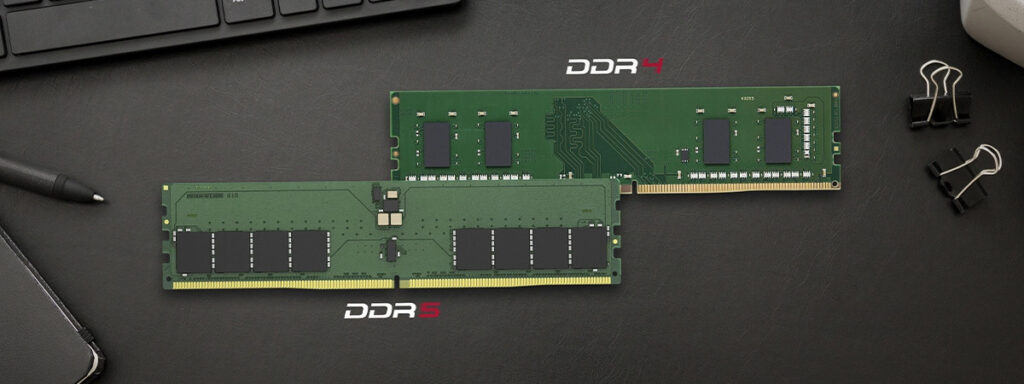
In gaming every millisecond counts whether you’re chasing a high score, competing online, or exploring a new VR world. While graphics cards and processors often steal the technology spotlight, it is memory that plays the most vital role in keeping gameplay smooth and responsive. The introduction of DDR5 DRAM has redefined the baseline for system performance and efficiency. However, according to memory specialist, Kingston Technology, both DDR5 and DDR4 modules have a part to play in transforming the gaming experience.
Each generation of DDR memory has evolved, increasing data transfer rates, enhancing data integrity, expanding capacities and lowering energy consumption. Gamers who are looking to upgrade a compatible PC with DDR4, for example, can benefit from improved performance without the cost of replacing the motherboard or processor. In addition, choosing DDR4 could leave some of the available budget to add a good graphics card, SSD or other component that will positively affect the gaming experience. Gamers should ensure that any upgrade they make will actually deliver a difference because some systems are constrained by the GPU, so adding memory will not ensure better graphics.
“DDR5 DRAM has set a new standard for gamers,” said Matteo Occhi, Field Application Engineer at Kingston Technology. “However, DDR4 remains an excellent choice for users looking for solid, reliable performance across compatible Intel LGA 1700 and AM4 systems, supporting not just entry-level gaming but browsing, streaming and office work. For many, having enough memory capacity will matter more than switching to a new generation of DRAM.”
DDR5 switches gamers up a gear
As the world of gaming becomes more complex and fast moving, Kingston Technology advises that to fully optimise the power of DDR5 DRAM gamers should ensure the processor, graphics card, game and settings can work in tandem and that the system is not memory or GPU limited.
The company stresses that DDR5 is a strong choice for new platforms and performance-focused PC builds thanks to its higher bandwidth and significant architectural improvements. These allow the new module to support higher-density memory chips and include a Power Management IC that regulates and distributes power precisely where and when it is needed most.
“Many modern game engines are memory-bound,” continued Matteo Occhi. “The higher bandwidth of DDR5 is a distinct advantage. When it comes to speed, DDR4 JEDEC standard speeds, for example, top out at 3200MT/s while DDR5 started at 4800MT/s and has now scaled to 6400MT/s on Intel 800-series platforms. That’s delivering double the speed, so you can imagine what it does for gaming performance!”
An eye on the memory road ahead
Looking to the future, next generation PCs and servers are expected to support DDR5 speeds of 7200MT/s, 8800MT/s, and 9200MT/s. These speeds represent not only the data rate, but also bandwidth. A DDR5-6400 class module, for example, has a peak bandwidth of 51.2GB/s in single channel mode, which doubles in dual-channel mode when an identical pair of modules is installed.
Kingston Technology warns against mixing DDR4 and DDR5 RAM on the same motherboard because they are not socket-compatible, have unique pin layouts and operate on different voltages and signalling standards.
Gamers who want more detailed advice on the differences between DDR4 and DDR5 modules, can check out the Kingston Technology website and read a useful guide on performance, compatibility and platform support.




More Stories
Coleg Cambria powers business growth and skills revolution across North Wales
Rapid Fusion fires up Prometheus launch with new international collaboration
Lawyer calls for action ahead of International Day to end Violence Against Women