




Written by Christopher Rogers
If you’re of a certain age, you’ll probably remember the heady days when Pinot Grigio was king. A generation of wine drinkers had come of age just as the UK wine market was embracing varietal labelling and making wine feel far more accessible. Suddenly, you didn’t need to know what grapes were in the bottle, where it came from or how to pronounce the region. You simply knew that you liked Merlot, loved Pinot Grigio or couldn’t stand Chardonnay, and that was enough.
Television programmes such as Food and Drink, alongside influential writers like Malcolm Gluck and his bestselling book Superplonk, encouraged consumers to explore further and helped create a new confidence around wine. As tastes evolved, however, Pinot Grigio’s crown began to slip. Drinkers wanted more flavour, more character and a little more excitement. Sauvignon Blanc was perfectly positioned to answer the call.
For the best part of two decades, Sauvignon Blanc has been one of the UK’s great white wine success stories. Whether from New Zealand’s Marlborough region or the vineyards of the Loire Valley, consumers embraced its vibrant aromatics, crisp acidity and unmistakable freshness. Yet success can sometimes become its own challenge. As New Zealand Sauvignon Blanc has grown ever more intense, with increasingly ripe tropical fruit flavours and pungent aromatics, some drinkers are beginning to look elsewhere.
Not for something radically different, but for a wine that offers the same refreshing bite and food-friendly acidity, while delivering a little more subtlety, balance and complexity. Which raises an intriguing question: could Spain’s Verdejo be the next logical step for Sauvignon Blanc drinkers?
The Rueda Region – and The Verdicts from Two Tasting Groups
To set the scene, let’s look at Rueda itself. Sitting on Spain’s high central plateau, the region experiences hot, sunny days tempered by significantly cooler nights. Those dramatic temperature swings help preserve acidity while allowing grapes to achieve full ripeness. The result is a style of wine that combines Mediterranean fruit with an almost Atlantic freshness. It’s a combination that gives Verdejo its distinctive personality and explains why it can feel both generous and refreshing at the same time.
To answer the question of whether this could be the perfect replacement for Sauvignon Blanc, I recently gathered two tasting groups and put four Verdejos in front of them blind. Here’s the verdict:
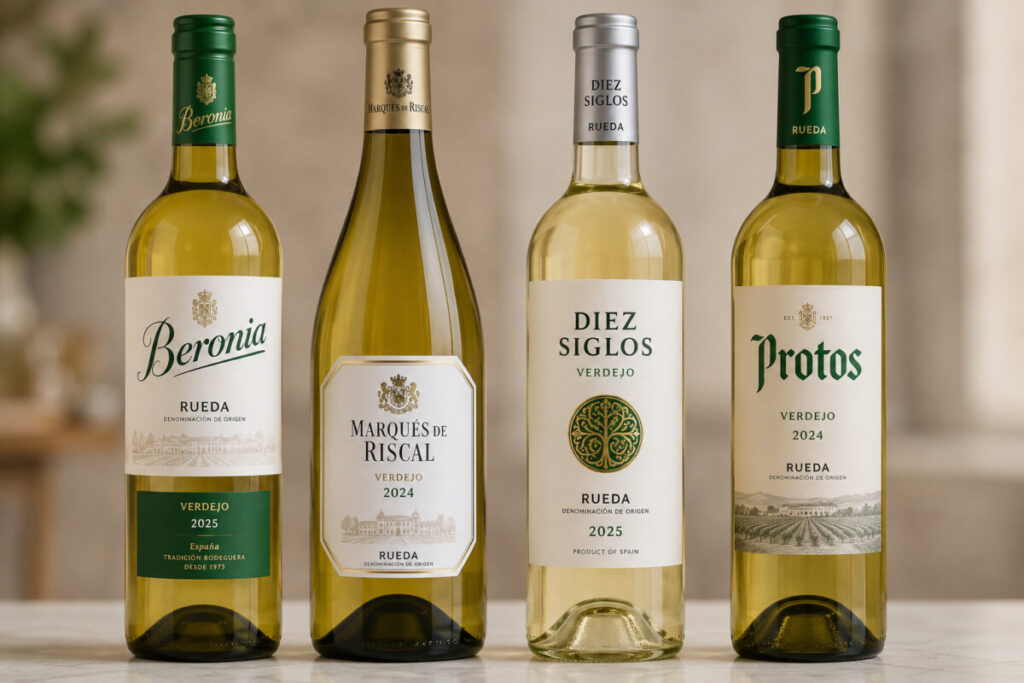
The wines came from some of Rueda’s best-known producers and represented both the 2024 and 2025 vintages. The aim wasn’t to find the best Verdejo on the market, but to explore the style and see whether it genuinely offers something that Sauvignon Blanc drinkers might find appealing.
Marqués de Riscal Rueda 2024: Light and Approachable
The first wine, Marqués de Riscal Rueda 2024, immediately demonstrated why the comparison exists in the first place. Aromas of green pepper and fresh herbs emerged from the glass, while the palate delivered a crisp, herbaceous freshness. One group said they particularly enjoyed its lighter touch.
What struck me was how this Verdejo delivered many of the things people enjoy about Sauvignon Blanc without quite the same intensity. It was fresh and flavourful, but never aggressive. A little simpler than some of the others perhaps, but very approachable.
Diez Siglos Rueda 2025: A fruity, rich and more full expression
Wine number two, Diez Siglos Rueda 2025, took Verdejo in a completely different direction. Here the fruit became much riper and more exotic. Apricots, stone fruits and even passion fruit were suggested by the tasting groups. The texture was fuller too, giving the wine a richer, more viscous feel.
While everyone enjoyed all the wines, this one proved the least popular wine of the four within the groups. Several tasters felt it lacked the acidity needed to balance its generous fruit character. For me, it almost wandered into Viognier territory. It was pleasing as a wine, but I felt it lost some of the freshness and precision that make Verdejo distinctive in the first place.
Beronia Rueda 2025 – taster’s favourite – a ‘Midsummer picnic’
The third wine, Beronia Rueda 2025, was, for me, where everything seemed to come together.
One group described it as “a Midsummer picnic” complete with strawberries, cream, elderflower and sunshine. The other found grass, citrus and bell pepper. Both groups, however, agreed on one thing: balance.
This wine combined plenty of flavour with an almost effortless sense of freshness. There was bright acidity, but no sharpness. Plenty of fruit, but no excess. It managed to be expressive without becoming overblown.
In many ways, it perfectly illustrated Verdejo’s appeal. Where some modern Sauvignon Blancs seem determined to turn every dial up to maximum, this wine showed that flavour can be delivered with a lighter touch. Unsurprisingly, it emerged as the overall favourite of both the tasting groups and my own personal winner.
Protos Rueda 2024 – Greener style – balanced and enjoyable
The final wine, Protos Rueda 2024, returned to a greener style, showing aromas of hedgerow herbs, green fruits and bell pepper. One group picked up a fresh spring onion character, alongside a subtle creaminess on the palate.
It was refreshing, balanced and enjoyable, althoughI loved the depth and complexity shown by my personal favourite, the Beronia.
Interestingly, however, Protos Rueda 2024 emerged as the favourite wine for one of the tasting groups, which perhaps reinforces the point that freshness and drinkability remain central to Verdejo’s appeal.
Perfect Partners for a Meal
The most revealing part of the tasting wasn’t necessarily which wine won, but how the groups responded to Verdejo as a category.
One group in particular really enjoyed the wines and repeatedly commented on how well they would work alongside food. Again and again, the discussion returned to balance. These weren’t wines trying to dominate the glass; these were wines that seemed designed to accompany a meal.
That, I believe, may ultimately be where Verdejo has its greatest opportunity.
Sauvignon Blanc remains enormously successful and isn’t going anywhere – but as consumers become more adventurous and their palates develop, many are looking for wines that offer freshness without excess and character without overwhelming intensity.
Verdejo seems perfectly placed to fill that gap.
So much more than ‘Spain’s answer to Sauvignon’
Is Verdejo taking over from Sauvignon Blanc? Probably not right now – but many drinkers are in the market for something a little different – and in my view, Verdejo may well become the next wine that Sauvignon Blanc drinkers discover when they want something a little more nuanced.
If this tasting taught me anything, it’s that Verdejo has moved beyond being simply “Spain’s answer to Sauvignon Blanc”. At its best, it offers something entirely its own: freshness, balance, versatility and just enough complexity to keep you coming back for another glass.
And in today’s wine market, that sounds like exactly the sort of wine many people are looking for.
—
These wines are available at Sainsbury’s, Waitrose, Majestic and Amazon – and make a perfect partner for summer dining.
—
About the author
Christopher Rogers brings nearly 30 years of experience in the wine and spirits industry.
Based in Wales, Chris is a holder of the WSET Diploma and an Associate of the Institute of Wine and Spirits, Chris is also a graduate and winner of L’Academie de Champagne and a Chevalier de l’Ordre des Coteaux de Champagne.
Chris is also the Founder of The Splendid Wine Agency, which represents a number of international brands in the UK.




More Stories
Coleg Cambria powers business growth and skills revolution across North Wales
Rapid Fusion fires up Prometheus launch with new international collaboration
Lawyer calls for action ahead of International Day to end Violence Against Women