




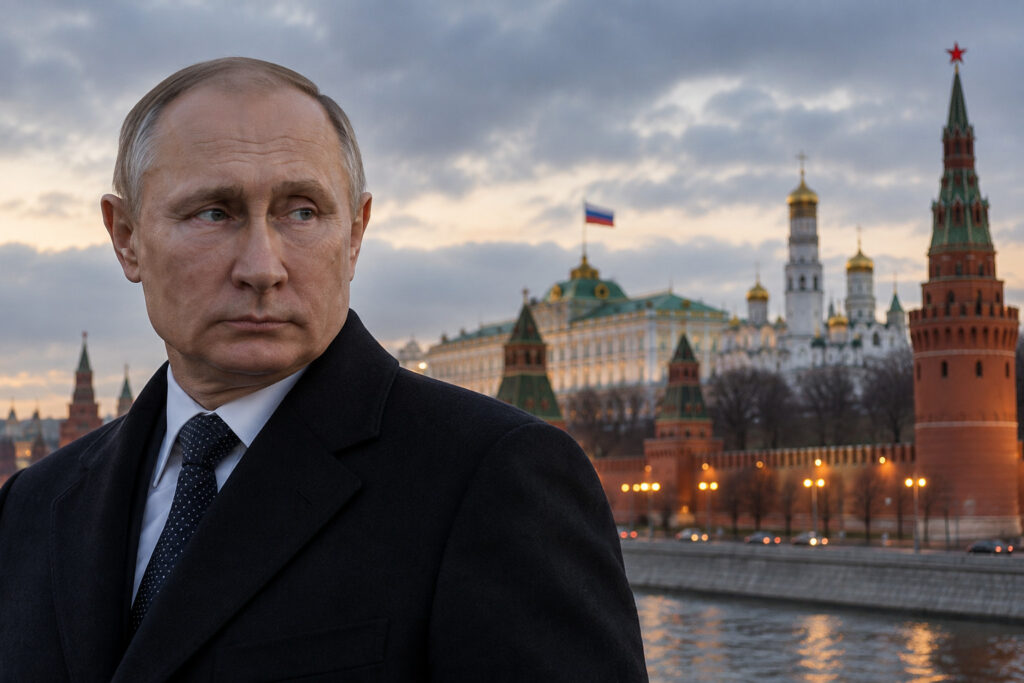
Vladimir Putin’s latest threats have raised fears about whether Russia could attack the UK. But how serious is the threat to Britain, could Putin really use nuclear weapons, and what should people in the UK actually be worried about?
Vladimir Putin’s increasingly hostile rhetoric towards Britain has generated alarming headlines, raising an uncomfortable question for millions of people: could Russia actually attack the UK?
The possibility cannot simply be dismissed. Russia possesses nuclear weapons capable of reaching Britain, while the UK has become one of Ukraine’s most prominent military and political supporters.
However, there is a considerable difference between Putin threatening Britain and Russia actually launching an attack.
Based on the evidence currently available, there is no reason for people in Britain to believe a Russian nuclear attack is imminent.
There are, however, other Russian threats to the UK that are considerably more realistic – including cyberattacks, sabotage, espionage and disruption to critical infrastructure.
There is also the potentially more dangerous long-term possibility of Russia and NATO being drawn into a confrontation through miscalculation rather than deliberate intent.
What Has Putin Threatened Britain With?
One of the most unsettling recent moments came when Putin was questioned about the possibility of Russian attacks on British military facilities because of the UK’s continuing support for Ukraine.
His deliberately cryptic response was:
“That’s a secret. A military secret.”
It is exactly the kind of statement likely to generate dramatic headlines about Putin threatening Britain.
But threatening rhetoric is not the same thing as evidence that Russia is preparing an attack on the UK.
Russia has repeatedly issued warnings about escalation and nuclear weapons throughout the war in Ukraine.
The UK Government has previously characterised Russian nuclear rhetoric as a form of “coercive signalling”, intended to increase the perceived risks associated with Western support for Kyiv.
Nevertheless, Britain has also acknowledged an important danger: repeated nuclear signalling increases the possibility of misunderstanding and miscalculation between nuclear-armed states.
Could Putin Launch A Nuclear Attack On The UK?
The risk of Russia deliberately launching a nuclear attack on Britain currently appears very low, although no responsible assessment could describe it as absolutely zero.
Russia unquestionably possesses nuclear weapons and delivery systems capable of striking the UK.
But there is an enormous strategic barrier between possessing that capability and deciding to use it.
Britain is both a nuclear-armed country and a member of NATO.
An intentional Russian nuclear strike against the UK would risk triggering a catastrophic confrontation with an alliance of 32 countries.
Three NATO countries – the United States, UK and France – possess nuclear weapons.
Putin and Russia’s military leadership would therefore have to contemplate the possibility that an attack on Britain could ultimately result in devastating retaliation against Russia itself.
That is the fundamental principle behind nuclear deterrence.
Would NATO Defend Britain If Russia Attacked?
Britain is a founding member of NATO and is protected by the alliance’s collective defence arrangements.
Article 5 of the North Atlantic Treaty establishes the principle that an armed attack against one NATO member is considered an attack against them all.
That does not mean every hostile Russian action would automatically produce nuclear retaliation or even an identical military response.
The circumstances of an attack would matter enormously.
But deliberately launching missiles at Britain would create an entirely different situation from the current proxy confrontation surrounding the war in Ukraine.
Instead of fighting Ukraine while attempting to avoid direct conflict with NATO, Russia could find itself confronting the world’s most powerful military alliance.
That provides Moscow with a very powerful reason not to attack Britain directly.
The More Realistic Russian Threat To Britain
The Russian threat most likely to affect the UK may be considerably less dramatic than nuclear war.
Cyberattacks, sabotage, espionage, disinformation, GPS interference and attacks or interference involving critical infrastructure all fall within what security experts commonly describe as hybrid or “grey-zone” warfare.
These tactics offer Russia an important strategic advantage.
They can potentially cause substantial disruption while making it difficult to determine whether the threshold for a conventional NATO military response has been crossed.
NATO has warned that hostile Russian actions, including cyberattacks and sabotage, are increasing in frequency.
European governments have also become increasingly concerned about suspected Russian activity involving infrastructure, communications and transport.
For people living in Britain, this is therefore a much more plausible threat than an incoming Russian nuclear missile.
A sophisticated cyberattack affecting energy supplies, banking, communications, transport or government systems could cause considerable disruption without Russia firing a conventional weapon at Britain.
Could Russia Attack UK Infrastructure?
Critical infrastructure is consequently one of the areas Britain must take particularly seriously.
Modern societies depend on interconnected electricity networks, telecommunications, internet infrastructure, satellites, financial systems and subsea cables.
Disrupting those systems can potentially have enormous economic consequences.
Britain and its allies therefore face the difficult challenge of protecting infrastructure while determining exactly when hostile activity becomes an “attack” requiring a military response.
And that leads to perhaps the most worrying aspect of the current confrontation.
The Biggest Risk May Be Russia And NATO Miscalculating
The greatest danger may not be Putin deliberately deciding to start World War Three.
It could be a sequence of events that gradually produces one.
Imagine that serious sabotage occurs against infrastructure belonging to a NATO country.
Intelligence agencies conclude Russia was responsible.
NATO retaliates.
Russia responds.
Each side believes its actions are proportionate, but each response increases the stakes.
A confrontation that neither originally wanted could gradually become much harder to control.
Similar risks exist when Russian and NATO military aircraft, ships, drones and missiles operate in relatively close proximity.
During periods of extreme geopolitical tension, apparently minor incidents can have enormous consequences.
That is one reason why maintaining communication between Russia and Western governments remains important even when relations are exceptionally poor.
Why Does Putin Keep Threatening Britain?
There is also a psychological element to Putin’s rhetoric towards the UK and other Western countries.
Russia does not necessarily need to attack Britain for threats against Britain to have an effect.
If British voters become sufficiently frightened about the possibility of war with Russia, political pressure could grow for the UK Government to reduce its support for Ukraine.
Strategic ambiguity can therefore be useful to Moscow.
A statement such as “that’s a military secret” allows Putin to imply something extremely threatening without committing Russia to a specific course of action.
The resulting headlines can amplify that message enormously.
That does not mean Putin’s threats should simply be dismissed as propaganda.
Instead, they need to be assessed against Russia’s actual military capabilities, behaviour and strategic interests.
Is A Russia-UK War Likely?
At present, a direct war between Russia and the UK remains unlikely.
Russia has issued numerous warnings about Western “red lines” since its invasion of Ukraine without subsequently launching a deliberate military attack against NATO territory.
That history cannot guarantee what Russia will do in the future.
It does, however, provide important context when assessing claims that a Russian attack on Britain is imminent.
There are also continuing diplomatic efforts surrounding the war.
On September 7, the Kremlin indicated that it was not ruling out restarting peace talks involving Russia, Ukraine and the United States.
That certainly does not mean peace is imminent.
But it demonstrates an important feature of international relations that can become obscured by frightening headlines: threatening rhetoric and diplomacy can occur simultaneously.
How Worried Should People In The UK Be About Putin?
For ordinary people in Britain, the current situation does not justify living in fear that Russia is about to launch a nuclear attack on the UK.
There is no convincing public evidence that such an attack is imminent.
That does not mean Britain’s security environment is comfortable.
A reasonable assessment separates several very different risks.
An intentional Russian nuclear attack against Britain would be catastrophic, but currently appears extremely unlikely.
A conventional Russian military attack on the UK also remains unlikely because it could trigger a much wider confrontation with NATO.
Cyberattacks, espionage, sabotage, disinformation and interference with infrastructure are considerably more credible threats.
Perhaps the most dangerous longer-term possibility is an incident involving Russia and NATO escalating beyond what either side originally intended.
Putin’s Threats Are Serious – But Panic Is Not Justified
The international security environment facing Britain is unquestionably more dangerous than it was before Russia’s invasion of Ukraine.
Putin’s threats therefore should not be ignored.
Britain has good reason to strengthen its military capabilities, cyber defences, energy security, telecommunications resilience and protection of critical infrastructure.
Diplomacy and effective communication between nuclear powers are equally important.
But there remains a huge difference between acknowledging that Russia represents a serious security threat and concluding that Putin is preparing to launch nuclear missiles at Britain.
On the evidence currently available, Britons should be alert to the threat from Russia – but they should not be panicking about an imminent nuclear attack.
Sources And Further Reading
NATO – Strengthening NATO’s Eastern Flank:
https://www.nato.int/en/what-we-do/deterrence-and-defence/strengthening-natos-eastern-flank
UK Government – UK condemns Russia’s destabilising nuclear rhetoric and RS-28 Sarmat missile signalling:
https://www.gov.uk/government/speeches/uk-condemns-russias-destabilising-nuclear-rhetoric-and-rs-28-sarmat-missile-signalling-uk-statement-to-the-osce
Reuters – September 7, 2026 – Kremlin comments on the possibility of restarting Russia-Ukraine-US peace talks:
https://www.reuters.com/world/europe/kremlin-says-it-does-not-rule-out-restart-peace-talks-with-ukraine-us-2026-09-07/
Reuters – September 1, 2026 – Putin’s comments on the war and negotiations:
https://www.reuters.com/world/europe/putin-says-russia-is-winning-battlefield-wont-negotiate-with-terrorists-2026-09-01/




More Stories
King Charles ‘Said Diana Would Soon Be Forgotten’, Her Brother Claims in New Book
Amazon announces above-inflation pay rise – to a minimum starting salary of more than £31,000 for full-time UK operations employees
UK Households Told to Prepare for Emergencies – How Real Is the Risk?