




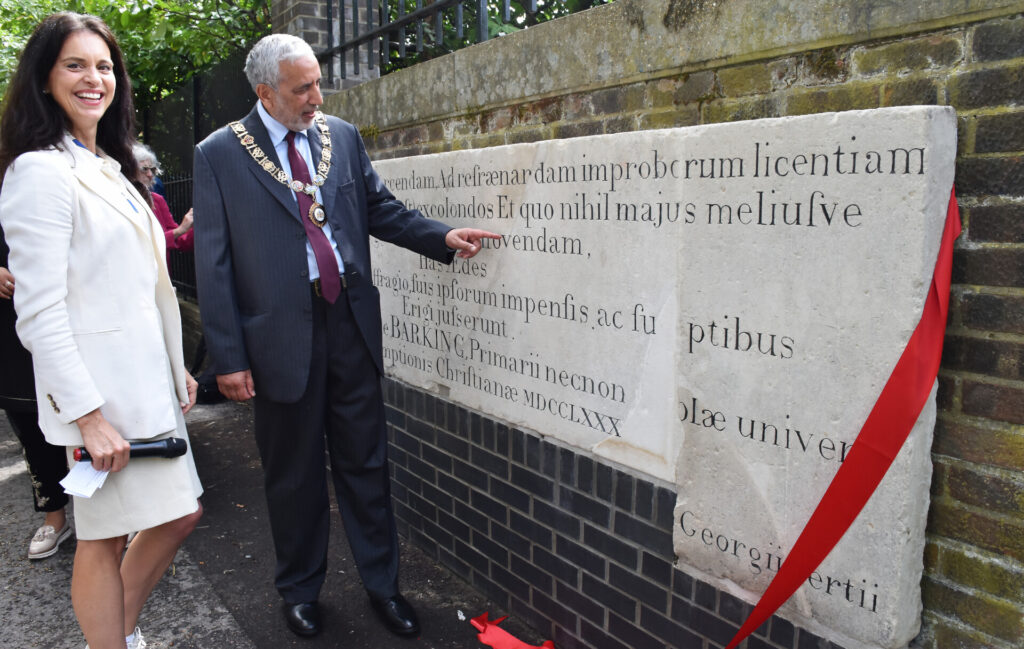
A rare surviving fragment of Barking’s eighteenth-century workhouse has been restored and officially unveiled on Abbey Green on Wednesday 17 June, offering a powerful reminder of how London once responded to poverty and hardship.
The large Portland stone plaque, originally mounted high on the Georgian workhouse on North Street, is the only surviving remnant of a building that once dominated Barking’s civic life. Demolished in 1936, the workhouse has long since vanished from the townscape. Its former site is now occupied by an Asda superstore. The plaque, salvaged at demolition, spent decades lying in pieces in the kitchen garden at Eastbury Manor House.
Heritage of London Trust worked with BeFirst, the London Borough of Barking and Dagenham’s regeneration delivery agency, to restore the stone and install it on the wall outside St Margaret’s Church of England Primary School on Abbey Green. The project was supported also by the Jones Day Foundation and by Weston Homes, which is delivering over 1,000 homes, commercial and community spaces at Abbey Quay opposite Abbey Green Park.
The plaque was unveiled on Wednesday 17 June, returning this important piece of Barking’s history to public view for the first time in decades.
The restoration project has engaged over 220 local young people so far through Heritage of London Trust’s Proud Places programme. Students from Barking Abbey School and Eastbury Community School visited the plaque, met conservators and explored the social history behind the inscription.
Young people from Future Youth Zone also took part in creative workshops inspired by the plaque. St Margaret’s Church of England Primary School pupils will continue to learn about the plaque and its significance through a programme of activities linked to its new permanent home.
The workhouse plaque is composed of three sections of Portland stone, significantly weathered and split after years exposed to the elements. Conservation work, carried out by Cliveden Conservation, has stabilised the stone and improved the legibility of the carved lettering, much of which survived thanks to historic paint infill. The plaque now stands once again within the community that originally funded the workhouse in 1788.
A translation of the Latin reads:
“This house, of honourable industry, was built and paid for, by the distinguished members of Barking Parish, to restrain the disorder of the wicked and improve the spirit of the poor, for the glory of God.
178[6] – the 26th year of the reign of [King] George III.”
The restoration offers an opportunity to reflect on a chapter of London’s welfare history that has largely disappeared from view. Workhouses shaped the lives of thousands of Londoners for more than two centuries, yet many former sites remain unmarked. The restored plaque provides a tangible link to changing attitudes towards poverty, charity, and social care.
Dr Nicola Stacey, Director of Heritage of London Trust, said:
“Workhouses are incredibly rare survivors in London’s heritage but tell such an important story of how society addressed poverty and hardship in the past. This fragment of Barking’s workhouse has been beautifully restored and brings its history to life. It also gives us a chance to reflect on ideas about welfare and how this has evolved over the last 250 years.”
Cllr Simon Perry, Cabinet Member for Culture and Heritage, said: “I’m thrilled to see this restored plaque unveiled in the heart of Barking. The workhouse which once stood nearby was an important part of Barking history, and it’s important that we’re able to share its significance with new audiences. It was great to work with the Proud Places programme to involve students from across the borough in this project, helping them to understand the significance of heritage and conservation providing opportunities to find out about residents’ lives over 200 years ago, and how they are part of this borough’s heritage too.”
Dr Niall O’Flaherty, author of ‘Ideas of Poverty in the Age of Enlightenment’ said: “Workhouses responded to the objectives of the Poor Laws: to punish vagrants and idlers, to relieve the impotent poor, and to set the able-bodied to work. Many philanthropists, however, aimed to shape the character of its inmates – particularly children – through the discipline of labour, which was believed to instil patience, obedience, and industry. This intriguing plaque invites us to reflect on changing attitudes through time and is a visible reminder of the precarious existence endured by those compelled to enter the workhouse.”
Abbie Simpson, Land & Partnerships Director at Weston Homes, said: “Weston Homes is proud to support the restoration of this significant piece of Barking’s history. As we build the new community at Abbey Quay, we believe it is vital to preserve the heritage that shaped this area. This project not only honours the past but provides a meaningful landmark for the generations who will call Barking home in the future.”
Kris Zykubek, Senior Conservator, Cliveden Conservation said:
“Intensive biological growth had completely obscured the stone surface and inscription, so conservation cleaning was our first step. Once revealed, traces of black paint in the cut letters led us to repaint the lettering black for authenticity. We reattached broken sections using stainless steel dowels and weather-resistant resin, installed new stone indents where sections were missing, and carried out mortar repairs to the weathered surface. The transformation is amazing, I am so glad that we could save most of the inscription, which describes the origins and significance of Barking Workhouse.”




More Stories
Coleg Cambria powers business growth and skills revolution across North Wales
Rapid Fusion fires up Prometheus launch with new international collaboration
Lawyer calls for action ahead of International Day to end Violence Against Women