




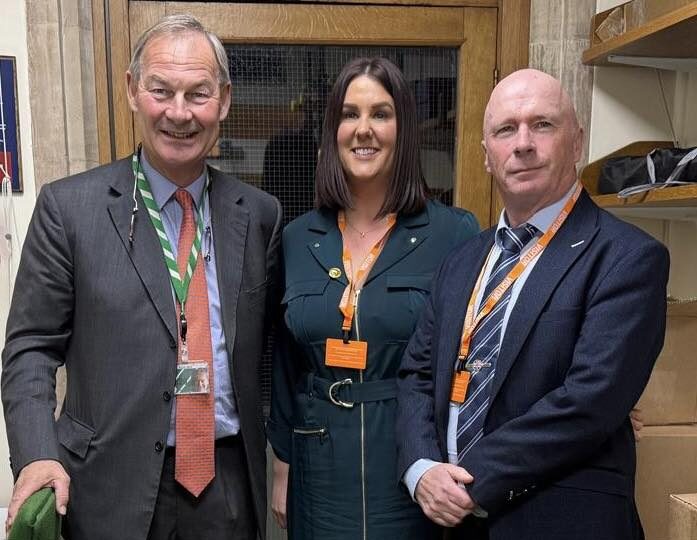
Lucy Connolly visited the House of Commons yesterday as MPs met to debate a petition submitted by Rupert Lowe MP which questions penalties for social media posts, drawing attention from supporters and policymakers across Westminster. Connolly observed the debate from the public gallery, as Parliament considered the issues raised and the public momentum behind the petition.
Lucy Connolly, a Mum of three, controversially received a 31 month custodial sentence for posting a tweet that she deleted a short time later. Now released under licence, she has used her experience to speak out on digital-expression, sentencing and the need for clearer guidelines around online conduct. Her presence at the Commons underscored how campaigners with direct experience are engaging with public policy debates.
Conservative leader Kemi Badenoch previously said Connolly’s 31 month sentence was “harsher than the sentences handed down for bricks thrown at police or actual rioting”.
The sentence contrasts starkly with the case of Sadnam Singh and Navjot Singh, who received a 2 year jail sentence for sexually assaulting a 14 year old teenager in her own home when delivering a TV to the property while her parents were out.
Background to Rupert Lowe’s Petition
The petition titled “Review possible penalties for social media posts, including the use of prison” calls on the Government to “urgently review the possible penalties for non-violent offences arising from social media posts, including the use of prison.”
Launched by Rupert Lowe, MP for Great Yarmouth, the petition argues that imprisoning individuals for non-violent online speech may set a dangerous precedent and poses risks to freedom of expression, proportionality in sentencing and the effective use of prison resources.
By the time of yesterday’s debate, the petition had amassed over 190,000 signatures, thereby fulfilling the threshold required for a formal debate in Parliament.
On 17 November 2025, Parliament debated the petition in full, allowing MPs to examine the concerns raised by signatories and consider potential policy responses.
Addressing members, Rupert Lowe said:
“The British State is now more willing to imprison somebody for a social media post than for a rape. That is not justice, that is not proportionate and that is certainly not the mark of a free country.”
When questioned over evidence for his remarks, Lowe stressed that further evidence in research on rape gangs due to be published in March 2026 would provide more insight into this.
Connolly’s Visit & Parliamentary Engagement
During her visit, Connolly met informally with several MPs and parliamentary staff to discuss the petition process, democratic participation and how individuals affected by online-speech regulation can engage with parliamentary channels. Though she did not speak in the chamber, her presence was noted by observers who highlighted the role of civic voices in democratic debate.
The debate itself featured contributions from across the House, as MPs considered questions of enforcement, proportionality and how the law handles digital-age issues. While the Government has already responded to the petition, stating that imprisonment is to be used only where no other sentence is appropriate, the discussion yesterday indicated sustained interest in the topic.
Observers described the session as constructive, noting that the presence of campaigners like Connolly signalled the growing intersection between grassroots involvement and parliamentary scrutiny.
Further updates on the petition’s implications and any subsequent policy announcements are expected in the coming weeks.
—
Image: MP RupertLowe



More Stories
Coleg Cambria powers business growth and skills revolution across North Wales
Rapid Fusion fires up Prometheus launch with new international collaboration
Lawyer calls for action ahead of International Day to end Violence Against Women